Showing posts with label mummies. Show all posts

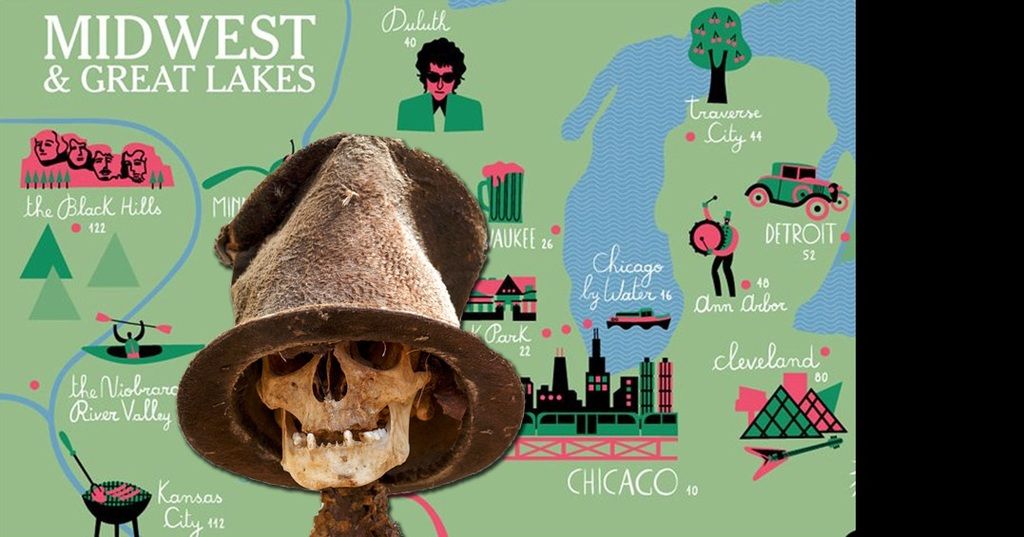
The Mummies of Guanajuato


A few months back, I posted a video of the intro to Werner Herzog's fantastic 1979 gothic horror film, Nosferatu The Vampyre. In it were incredible clips of twisted and shadowed mummified remains, overlayed with a hauntingly beautiful score by Popul Vuh. It's still one of the most striking, and personal favorite, intros to a horror film.

As I researched the intro, I was completely awestruck by the mummified figures, assuming that they were from the famous Capuchin Catacombs in Palermo, Italy. But I was actually wrong.

I discovered the shots were actually of a collection known as the Mummies of Guanajuato, Mexico. And while they weren't as famous as their Italian counterparts, they were nonetheless just as interesting.

From my previous post:
The famous collection of mummies from Guanajuato, Mexico dated back to an 1833 cholera epidemic. The naturally mummified remains were later unearthed after the failure of living relatives to pay 'burial taxes' of the time, and were stored together in an above-ground building adjacent to the cemetery. By the 1900s, these mummies began attracting tourists and eventually the building became a permanent museum.

(Tjalgahorn has since had a great post over at the October Branches blog on a new fungal growth spotted on one of the mummies - yes, The Last Of Us, indeed! Although in all seriousness, it could lead to decomposition and eventual loss of the mummies...)

The Museo De Las Mommas De Guanajuato houses the entire collection of 111 mummies, with 59 on permanent display. And their photography of the mummies is absolutely fantastic! A perfect source for Halloween prop reference, these photos have gone into my "inspiration folder" and will definitely be used for future prop reference.

Enjoy!


"Nosferatu The Vampyre" Opening Credits


The opening credits to Werner Herzog's 1979 German Gothic masterpiece, Nosferatu The Vampyre, has to be one of the absolute best in horror.


The credits open with incredible film footage of the Mummies of Guanajuato, a famous collection of mummies from Guanajuato, Mexico dating back to an 1833 cholera epidemic. (The mummified remains were later unearthed after the failure of living relatives to pay burial taxes of the time, and were stored together in an above-ground building adjacent to the cemetery. By the 1900s, these mummies began attracting tourists and eventually the building became a permanent museum. A bucket-list destination, for sure.)

Along with the stunning imagery of the twisted mummies overlays the hauntingly beautiful Gothic soundtrack from German electronic/organic ambient artists, Popol Vuh. The track, Brüder Des Schattens (Brothers Of The Shadow), sounds like something pulled from a dark, candle-lit monastery with orchestral strings, woodwinds, and monastic chants.

And over it all, the sound of the human heartbeat. The life pulse of the vampire.

The scene then transitions to a bat flying through the night sky, only to be suddenly shattered by the bloodcurdling scream of Lucy Harker, jolted awake from a terrible nightmare.

A perfect foreshadowing of events to come...

Enjoy.


(And if you're interested, you can see the entire film here!)


Vanitas: The Palermo Portraits by Matthew Rolston


All photos courtesy of Matthew Rolston/vanitasproject.com


Vanitas: The Palermo Portraits is a new photographic series from artist Matthew Rolston that documents the incredible "mummies" from the Capuchin Catacombs in Palermo, Sicily.

From his site:
MATTHEW ROLSTON’s latest photographic series, Vanitas: The Palermo Portraits, is comprised of portraits of mummified human remains housed in the Capuchin Catacombs of Palermo, Sicily, where the religious, aristocratic and affluent classes from the 16th through the early 20th centuries chose to display their dead, fully clothed, as a measure of societal and spiritual distinction, and in an effort to bring them closer to eternal salvation.


Absolutely stunning portraits of the many mummified inhabitants of the Capuchin Catacombs in Palermo. Each bathed in a blue glow, the earthen-toned figures maintain a warm, yet still somewhat horrific highlighted contrast. The orange and brown hues of the preserved flesh retain a strange lifelike tone to the ghastly remains of each figure.

The Capuchin Catacombs have been on my bucket list ever since I had first discovered their existence years ago. I'm absolutely fascinated with the mummified figures and that even with their sometimes advanced stages of decay, are accepted and viewed as an historic religious site. Someday, I will make it to this site and take in all of its wonderful sights.

And as a haunter, I find the Capuchin Catacombs to be an immeasurable source for reference material. The real-life mummification is on view for all to see, and for people like myself to use as a vastly important source when creating corpses in my home haunt crypt.

For more photos and a wonderful slideshow video of more of Rolston's gorgeous photos of the Capuchin Catacombs, please visit his site at vanitasproject.com.

There is also a great in-depth interview with Rolston on this project over at Vice.


A Lecture By Dr. Paul Koudounaris


Last night, I had the chance to hear a lecture by Dr. Paul Koudounaris, author of The Empire of Death: A Cultural History of Ossuaries and Charnel Houses, Heavenly Bodies: Cult Treasures and Spectacular Saints From The Catacombs, and his newest book, Memento Mori: The Dead Among Us, at Mac's Back Books In Cleveland.


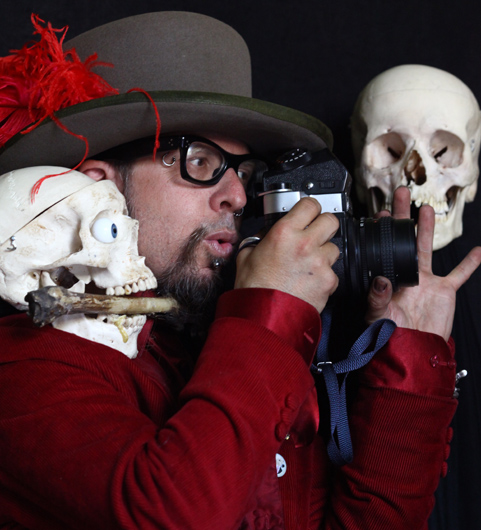
"Dr. Paul Koudournaris" by Dragoionescu - Own work. Licensed under CC BY-SA 3.0 via Wikimedia Commons - http://commons.wikimedia.org/wiki/File:Dr._Paul_Koudournaris.jpg#/media/File:Dr._Paul_Koudournaris.jpg


As someone who discovered Dr. Koudounaris' books by looking for photo references for Halloween prop display projects, I found the lecture remarkably fascinating. The historical and personal stories behind the photos gave substance to the art and gave me a deeper reference and connection to the Halloween projects themselves. And on a larger scale it gave me a new perspective, outside of our traditional Western custom, on death itself.


After the hour-long lecture, I was able to meet Dr. Koudounaris and discuss my pathway to discovering his work (his photos from the Santa Maria della Concezione in Rome, Italy were the inspiration for the talking skull cemetery greeter in my yard haunt). And after thanking him for the incredibly informative and interesting presentation, I geeked out a bit and had him sign my copy of The Empire of Death.


From the perspective of a Halloween prop builder, I cannot recommend Dr. Koudounaris' books enough. Each is filled with beautiful photography that is sure to inspire your next haunt project. But to seek out the books for photo reference only would be a disservice, as the rich amount of information supporting the photos is equally if not more interesting and inspiring.

Dr. Koudounaris' lecture tour continues and is highly recommended if it comes to your town. There are clips from his previous lectures on YouTube as well.


Dear Santa...


7 more days until Christmas, and I've finally figured out what I want from you. If you check your lists, you will most assuredly find me on the "Nice" list this year, as I tried not to terrify too many children this year at the Cemetery, I obeyed my parents and I always ate my vegetables. So if you could find it in your jolly heart, I only want one thing under my tree this year...

I REALLY want the book, Empire of Death: A Cultural History of Ossuaries and Charnel Houses, by Paul Koudounaris.

Thank you, Santa!

Love, Highbury


From Amazon.com:

From bone fetishism in the ancient world to painted skulls in Austria and Bavaria: an unusual and compelling work of cultural history.

It is sometimes said that death is the last taboo, but it was not always so. For centuries, religious establishments constructed decorated ossuaries and charnel houses that stand as masterpieces of art created from human bone. These unique structures have been pushed into the footnotes of history; they were part of a dialogue with death that is now silent.

The sites in this specially photographed and brilliantly original study range from the Monastery of Santa Maria delle Grazie in Palermo, where the living would visit mummified or skeletal remains and lovingly dress them; to the Paris catacombs; to fantastic bone-encrusted creations in Austria, Cambodia, the Czech Republic, Ecuador, Egypt, Germany, Greece, Italy, Peru, Portugal, Serbia, Slovakia, Slovenia, Spain, Switzerland, and elsewhere.

Paul Koudounaris photographed more than seventy sites for this book. He analyzes the role of these remarkable memorials within the cultures that created them, as well as the mythology and folklore that developed around them, and skillfully traces a remarkable human endeavor. 290 photographs, 260 in color.


I could think of no greater gift to a Halloween haunter like myself than a book such as this, just chock full of incredible information and absolutely beautiful photography. This would be a centerpiece of reference material sure to take Highbury Cemetery to the next level in 2012.

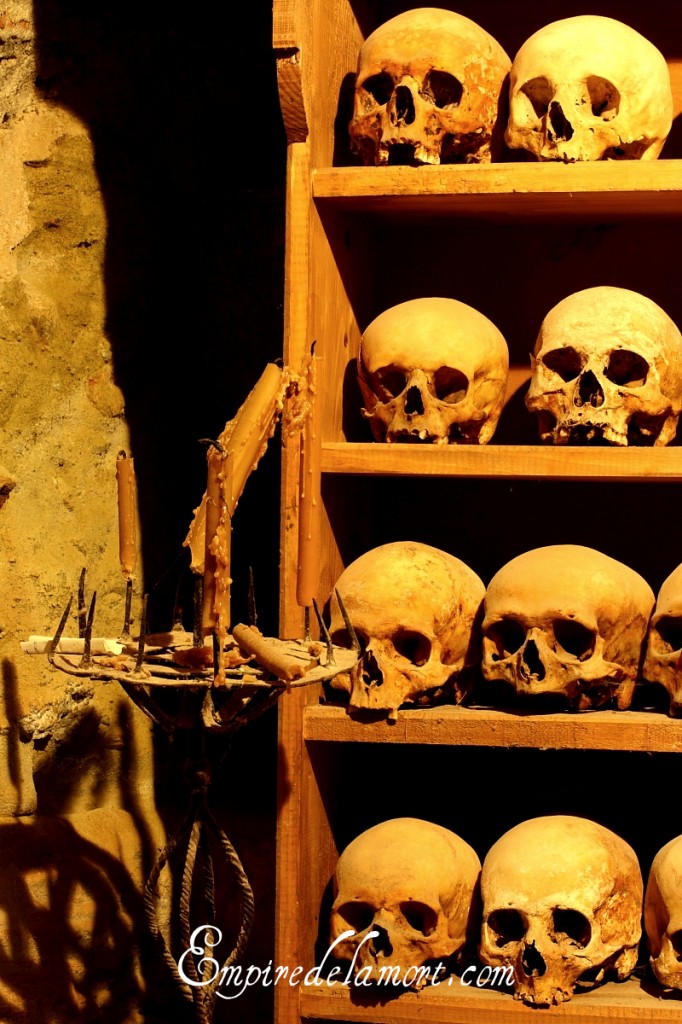
As an added bonus, you too can see the incredible collection of photographs at the book's accompanying website, Empire de la Mort. I visit this site regularly, perusing the beautiful photography and each time my mind races, planning to replicate every shot in next year's home haunt. All photos below are from Empire de la Mort. Do yourself a big favor and take a few minutes to check it out.